The Politecnico di Milano organizes the MSCA Masterclass for post-doc researchers who wish to apply for the MSCA European Postdoctoral Fellowship program. The aim is to offer them comprehensive support in the application process and increase their chances of success.
Moreover, the 5 best candidates not financed by the European Commission, but awarded the Seal of Excellence (SoE), will receive a two-year research grant to carry out their project.
PSE-Lab offers the following two research projects, both under the supervision of Prof. Davide Manca:
- Fuzzy vs Crisp Transition to Hydrogen-intensive Green Processes using as guidelines the Three Pillars of Sustainability
- Individualized Medicine for the Optimal Treatment of Patients
Applications to the Masterclass are open until May 7th, 2023: if interested, contact us for further details about the research topics and the eligibility requirements.
For more information to apply to the Master Class visit: https://www.polimi.it/en/faculty/working-at-the-politecnico/call-for-msca-pf-master-class-polimi or contact mscamasterclass@polimi.it for any questions on the funding scheme and the MSCA program.
All call details at the following address: https://bit.ly/MSCA2023Polimi
]]>
The research project will focus on the decarbonization of the production of base chemicals such as ammonia, methanol, nitrates. The project represents an important step to reduce the carbon footprint of the chemical industry and contribute to reach the Paris Climate Accords goals.
The Ph.D. candidate will employ an integrated process systems engineering approach to innovative green technologies and processes, assessing their environmental and economical feasibility in the production of base chemicals.
The Ph.D. grant lasts 3 years and provides a monthly scholarship of about €1325 during this period. The research project will be carried out in partnership with Casale SA, a Swiss company specialized in the technologies and know-how for the production of base chemicals. The candidate will spend six months at Casale SA, with an increased scholarship of about €1900 while abroad.
The call is open.
You can find all the information about the call and how to apply at the following link:
http://www.dottorato.polimi.it/en/looking-for-a-phd/call-for-positions-and-scholarships/calls/pon-calls/
The Ph.D. position is called “TOWARDS THE GREEN PRODUCTION OF BASE CHEMICALS“, and you can read its full description here.
If you are interested in this position, please apply.
The call is open until October 18th 2021, h14:00.
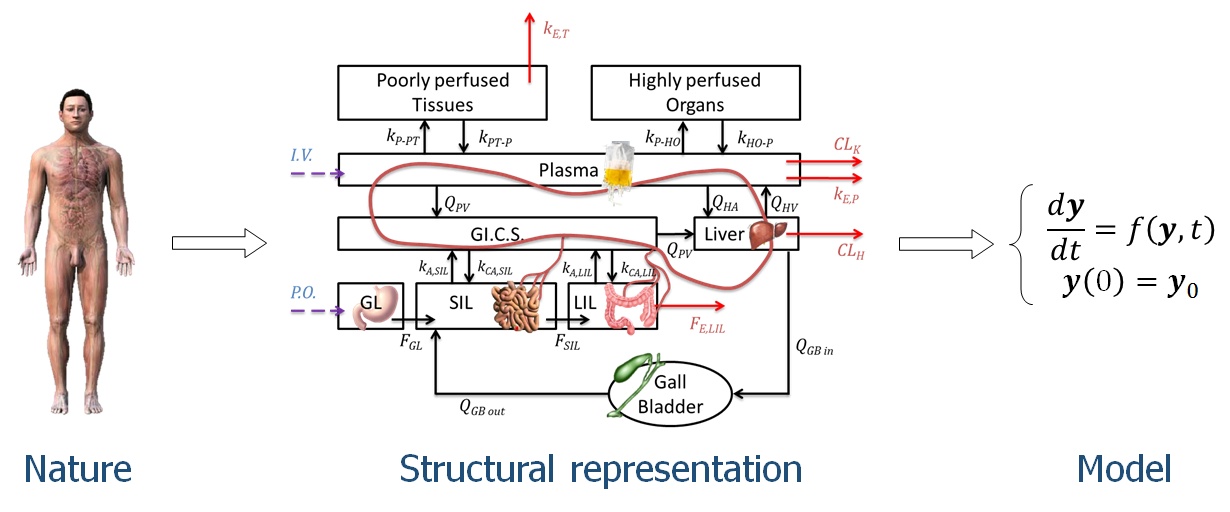
The knowledge of drug concentration-time profile in human body is crucial information for any kind of pharmacological treatment of diseases, furthermore it helps pharmaceutical companies developing new drugs.
Within the major field of pharmacology, pharmacokinetics is defined as the science that studies the effects of the organism action on the drug molecules. In general, any time a pharmacological treatment is given to a patient, drug molecules enter an extremely complex and dynamic environment, namely the human body.
All the phenomena involving the drugs within the human body are recalled with the acronym ADME, i.e. Absorption, Distribution, Metabolism and Elimination. The comprehension of these phenomena is crucial for the definition of pharmacokinetic models and requires the synergy of different sciences, for instance anatomy, physiology, chemistry, physics, statistics and interestingly some aspects typical of chemical engineering background: transport phenomena, reaction kinetics, process dynamics, and numerical analysis.
At PSE-Lab we pursue the definition of an advanced mathematical model based on mammalian physiology, to describe pharmacokinetic behavior of drugs. Our main activities are:
- Definition and improvement of a physiologically based pharmacokinetic model PBPK;
- Development of individualization strategies to reduce unpredictability due to inter-individual variability in human subjects;
- Combination of pharmacokinetic (PK) and pharmacodynamic (PD) predictions PK/PD.
Read Pharmacokinetic modeling: methods, potentials and perspectives for further information.
]]>Field Operators can thus exploit some of their senses, i.e. sight, sound, and touch (seldom smell) to crosscheck the perception that is formed by the interpretation of field data from sensors. Generally, there is a frequent coordination among Field Operators and Control Room Operators to carry out both conventional and unconventional operations of chemical plants such as: start-ups, shutdowns, grade changes, in-the-field monitoring, safety assessment, and remote reporting.


Abnormal situations may lead to near misses and even to severe accidents, which can result in production loss and even in casualties and fatalities. As soon as an abnormal situations happens, a problem-to-be-solved is raised and the need for re-planning the operations becomes essential. In order to respond to an abnormal situations, operators should demonstrate problem-detection skills and rapid re-planning strategies.
PSE-Lab provides services for Operators’ Training to enable them overcoming the abnormal situations according to the best-possible way and keeping the system/process near to the optimal setpoints (as shown in the figure below).


Every task demands difference cognitive processes. One shoe fits for all is not the answer to the development of Operator Performance Indicators. Thus, OPIs should be subjective to the processes and tasks. In addition, a weighing criteria among OPIs makes the assessment reliable and consistent.
The software developed in PSE lab i.e., Performex, integrates both Key Performance Indicators and Operator Performance Indicators.
]]>The Plant Simulator consists of coupling a conventional OTS (i.e. Operator Training Simulator) with an Immersive Virtual-Reality Environment (IVE) (commonly referred to as a 3D environment) that simulates the field in all its facets comprising spatial sound (commonly referred to as 3D sound). The Plant Simulator makes interacting in real-time three programs: a dynamic process simulator, a dynamic accident simulator (©AXIM), and a performance assessment algorithm (©Performex).
The core benefit of this solution, which is also a breakthrough with respect to conventional training solutions, is that the data exchange between the process simulator and the accident simulator allows:
 • tracking the dynamic evolution of the process when an accident occurs;
• quantifying the possible effects and damages on the structures and the equipment;
• quantifying the potential injuries that field operators would suffer in real life.
In addition, the constructs from Human Factors research are also integrated into the Plant Simulator. For instance, use of 3D environment which facilitates spatial and immersive learning. The Plant Simulator allows simulating various normal and abnormal situations, where trainees can practice and enhance their skills, which are necessarily required for normal operating conditions as well as for abnormal situation management. A conceptual representation of the Plant Simulator is shown below:
Â

]]>
The most important characteristic of Performex is the unbiased ranking and marking of actions performed by the trainee. Human judgments can be intrinsically subjective. Consequently, the assessment of operators by trainers is a complex function of trainer-trainee affinity/relationship and is subject to dynamic aspects that depend again on the human and subjective features of that binomial.
Performex has the following features:
- Integration of Key Performance Indicators
- Internal weighing among indicators with respect to their significance in the process
- Safety Based Indicators
- Internal weighing of indicators with respect to their impact on the overall safety
- Organization priority based Indicators
- Internal weighing of indicators according to the company priorities/policies
- Environment policies
- Production requirements
- Organization structure
- Geographical location and regional demands
- Internal weighing of indicators according to the company priorities/policies
- Integration of Operator Performance Indicators
- Indicators based on various Human Factors constructs
- Cognitive skills
- Physical skills
- Team working skills
- Cognitive demands of the task
- Situation Awareness
- Distributed Situation Awareness
- Indicators based on various Human Factors constructs
- Internal weighing among different indicators
- Use of Analytic Hierarchy Approach (AHP)
- Pairwise comparison among various indicators
- Saaty’s scale for a given scenario
- Consistency among pairwise comparisons
- Real time Performance Assessment
 shifts for complex or periodic procedures, planning training courses, recruiting, and possibly taking insurance related decisions.
Following is a brief list of topics covered in PSE Lab under the theme of Performance Assessment
- Identification of Key Performance Indicators
- Indicators based on process description
- Internal weighing of indicators with respect to their significance in the process
- Safety Based Indicators
- Internal weighing of indicators with respect to their impact on the overall safety
- Organization Priority based Indicators
- Internal weighing of indicators with respect to the organization prioritization
- Environmental policies
- Production requirements
- Organization structure
- Geographical location and regional demands
- Indicators based on process description
- Identification of Operator Performance Indicators
- Indicators based on various Human Factors constructs
- Cognitive Skills
- Physical Skills
- Team working skills
- Cognitive demands of the task
- Distributed Situation Awareness
- Indicators based on various Human Factors constructs
- Internal Weighing among different Indicators
- Use of Analytic Hierarchy Approach (AHP)
- Pairwise comparison among various indicators
- Defining Saaty scale for given scenario
- Developing consistency among pairwise comparison
- Real Time Performance Assessment
The tool developed in PSE Lab to evaluate Performance Assessment with above features is called Performex.
]]>The term Human Factors (HF) is considered equivalent to Ergonomics and these two terms are often interchangeable. The most accepted definition of HF which is  developed by International Ergonomics Association is as follows:
“Human Factors or Ergonomics is the scientific discipline concerned with the understanding of interactions among humans and other elements of a system, and the profession that applies theory, principles, data and methods to design in order to optimize human well-being and overall system performance.”
Human Factors research is composed of various theories and constructs analyzed together under one umbrella. Several collaborations have been established by the PSE lab in order to satisfy the demands of this interdisciplinary field of research. The relevant topics which are focused in PSE-Lab are listed below:
- Situation Awareness
- SA Models for Industrial Operators
- For Field Operators
- For Control Room Operators
- Factors Affecting SA of Industrial Operators
- Training Methods to Improve Industrial SA
- SA Models for Industrial Operators
- Further details about the theory of Situation Awareness (SA)
- Distributed Situation Awareness
- DSA Models for Industrial Operators
- For Field Operators
- For Control Room Operators
- Factors Affecting DSA of industrial operators
- Training methods to improve Industrial DSA
- Identification of Indicators constructing DSA in Process Industry
- DSA Models for Industrial Operators
- Further details about the theory of Distributed Situation Awareness (DSA)
- Teamwork analysis
- Key communication among teams
- Teams distribution in Field
- Teams distribution in Control Room
- Socio-Technical system
- Interaction of operators with technology and systems
- Cognitive demands and mental work load
- Operator response in abnormal situation
- Technology response in abnormal situation
- Decision making
The responsible member of research activity in the rubric of Human Factors at PSE-Lab is Salman Nazir. Â The head of PSE-Lab is Davide Manca.
]]>From rescue vehicles for industrial plants to warehouses and depots of munitions. From safety distances for both industrial and civil applications to design of road/railway tunnel fires for safety assessment of both the infrastructure and the mitigation devices.
- Design for safety
- Emergency rescue vehicles in harsh environments
- Refineries
- Toxic gases
- Fires
- Explosions and overturning
- Warehouses and depots
- Safety distances for
- Industrial and civil installations
- Civil buildings
- Moving targets such as vehicles and pedestrians
- Emergency rescue vehicles in harsh environments
- Safety in road and railway tunnels
- Design of experiments for fire in tunnels
- Optimal allocation of expenses for safety improvement